
|





David
Smick is founder, editor, and publisher
About The International Economy Magazine
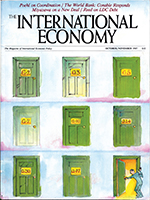
In early 1987, ten months before the stock market crash, we began to explore the idea of a nonprofit quarterly magazine covering global financial policy, economic trends, and international trade. It would come to be known as The International Economy. From the start, the Washington Post tagged the publication as “precocious.” The journal is edited for and read by central bankers, politicians, and members of the financial community including professional investment managers, macroeconomic specialists, and global The International Economy was officially launched at a VIP reception at the Federal Reserve in Washington, D.C., as new Chairman Alan Greenspan welcomed the new journal into existence. Bundesbank President Karl Otto Pöhl, by then Europe’s most influential policy leader, agreed to head the publication’s editorial advisory board. Within months, the Washington Post described The International Economy as “not some tiresome, gray journal but a publication consistently ahead of the curve.” The New York Times defined the magazine as follows: “Economist to economist, in English.” Later, the Washington Post said the magazine was “targeted to—and written by—the power brokers in the world of finance.” The publication has become a kind of policy bulletin board for financial decision makers, academics, and opinion leaders. The International Economy is intellectually independent and diverse. When Russian leader Boris Yeltsin was about to assume office and the international community was fixated on the nature of his economic reforms, Yeltsin’s chief economic strategist Grigory Yavlinsky came to Washington and met with various news outlets and think tanks. He chose The International Economy to publish the full text of Yeltsin’s economic/financial reform plan because of the publication’s broad diversity of intellectual support. The day after the plan’s publication, the New York Times ran a three-page story crediting The International Economy for this “scoop,” with other papers following suit. One reason for The International Economy’s early visibility is that the publication grew out of a series of influential global conferences involving many of the world’s most senior policy officials. Officially sponsored by the bipartisan U.S. Congressional leadership, these conferences took place over the course of a decade in Tokyo, New York, Washington, Frankfurt, Vienna, and Zürich. The first conference helped set the stage for the Plaza Accord, the G7 agreement to bring down the value of the U.S. dollar during heightened global trade tensions, according to Washington Post correspondent Hobart Rowen in his book Self-Inflicted Wounds: From LBJ’s Guns and Butter to Reagan’s Voodoo Economics. At a follow-up conference in Zürich, one of the conference sponsors, Senator Bill Bradley (D-NJ), floated the idea of developing world debt restructuring. The proposal within several years led to the issuance of the popular Brady bonds. Over the last thirty-five years, other publications have tried to compete with The International Economy, and none have succeeded. The Davos organization, for example, which sponsors the annual World Economic Forum in Switzerland, set up a competing publication which ceased any meaningful circulation within a few years. The Peterson Institute for International Economics set up a similar magazine. Despite the prestige of that institution, the publication closed its doors within several years. Yet The International Economy is still standing. That is because the magazine has remained a niche publication, concentrating on policy developments. Today there are roughly 10,000–20,000 economic and financial opinion leaders internationally of whom perhaps 3,000–5,000 truly impact the global economy as the prime movers in the public and private sectors. This is The International EconomySelf-Inflicted Wounds: From LBJ’s Guns and Butter to Reagan’s Voodoo Economics.s target audience. It is a skeptical crowd—very tough to reach where the number one commodity is independence of thought and diversity of viewpoint. At a time when the global economic and financial matrix is confusing and the commodities needed most are intellectual humility combined with curiosity about all things new, The International Economy continues to stand out.
HOME | BIO | TIE | BYLINE ARTICLES | CONTACT |
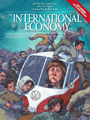
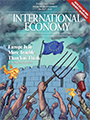
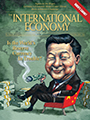
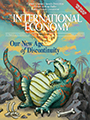
 investors. The magazine’s focused editorial content has attracted a loyal readership base among the world’s most powerful and influential decisionmakers.